Training & Qualifications
Make sense of the questions to ask when comparing pilot training pathways.
Explore Training & QualificationsPilotPath / Aviation careers
Prepare the right questions about training costs, payment arrangements and VET Student Loans.
How much does it cost to become a pilot?
Let's be upfront:
Flight training is not cheap.
The final cost of becoming a pilot depends on many factors, including:
The figures below are therefore rough guides only. Costs vary significantly between schools and individual students.
Flight training can be categorised as:
You fly with an instructor on board.
The instructor teaches, demonstrates and assesses your flying skills.
You fly the aircraft without an instructor on board, once your instructor has assessed you as competent and authorised you to fly solo.
Solo flying is an important part of pilot training because you need to demonstrate that you can safely operate the aircraft independently.
For an integrated CPL, CASA requires a minimum of 70 hours as pilot in command, which includes the required solo and pilot-in-command experience.
The number of hours you actually fly can be higher than the regulatory minimum.
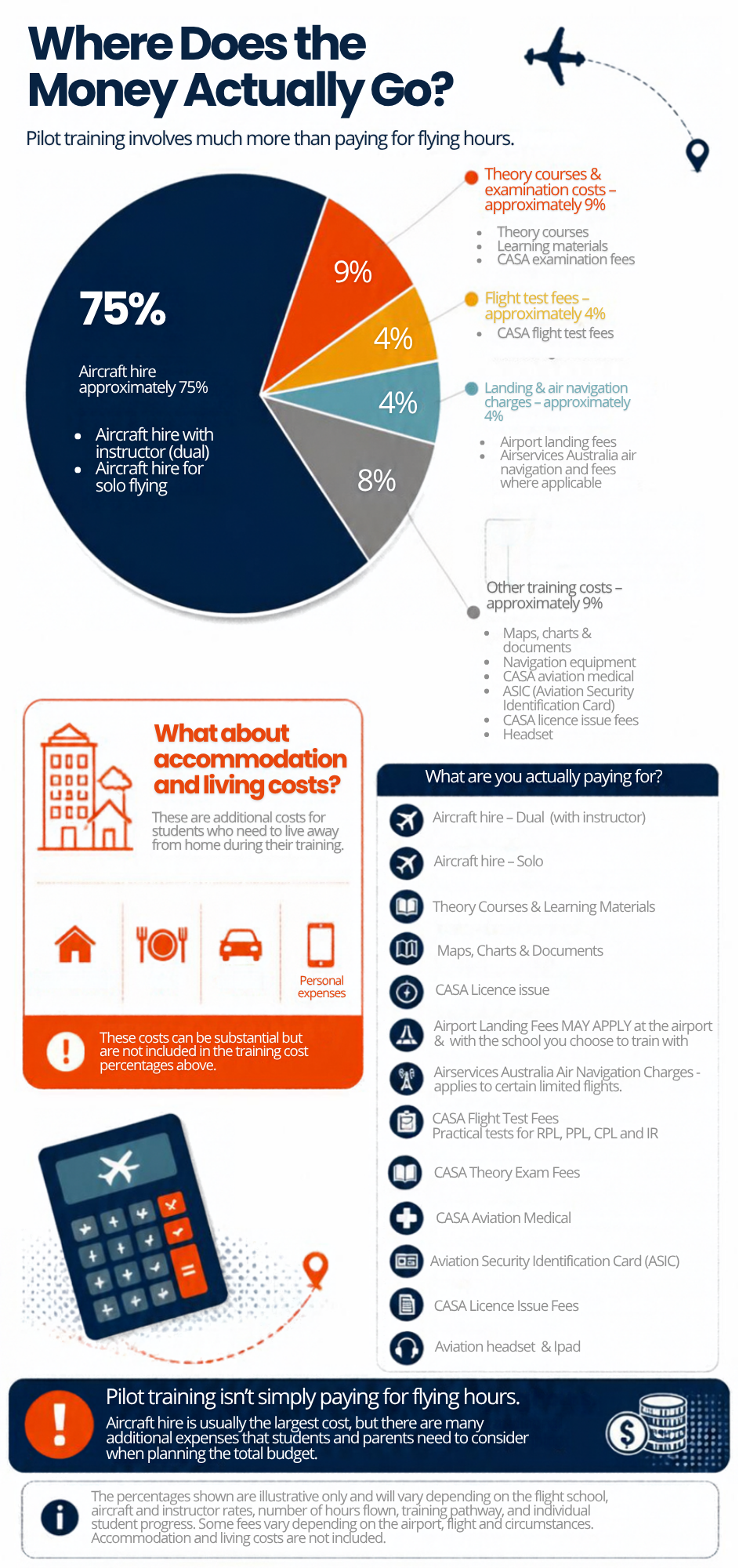
Flight hours are only part of the total cost.
You may also need to pay for:
Some schools include some of these costs in their advertised course price, while others charge them separately.
Always ask the school for a complete breakdown of what is included and what is not.
The following figures are intended only to give prospective students an idea of the possible cost of flight training in Australia.
| Training | Approximate cost |
|---|---|
| RPL only | $22,000–$25,000 |
| PPL Navigation phase | $14,000–$16,000 |
| Full PPL from zero | $36,000–$41,000 |
| CPL from zero (including RPL & PPL) | $85,000–$120,000 |
| Multi-Engine Instrument Rating | $35,000–$45,000 |
| Instructor Rating | ~$30,000 |
All figures are approximate Australian dollar estimates only and can vary between schools and students.
Two students can enrol in the same course and finish with different total costs.
One student might reach the required standard relatively quickly.
Another might need additional hours to reach the required competency for a particular skill or set of skills
The aircraft used also makes a significant difference.
A single-engine trainer, a high-performance aircraft and a multi-engine aircraft have very different operating costs.
The cheapest advertised course is therefore not necessarily the cheapest course to complete.
A good question to ask a flight school is:
"What does the course realistically cost for a typical student, including the additional fees and charges that are not included in the advertised price?"
This is something every prospective student should understand before enrolling.
If you need additional flying hours, you will normally have to pay for those hours.
For example, if your course is based on a particular number of flight hours but you need another 10 hours of training, those additional aircraft and instructor hours will add to your total cost.
The same applies if you need to repeat:
This is one reason why students should allow a financial buffer rather than budgeting only for the advertised minimum.
For eligible Australian students, some flight training organisations may offer aviation qualifications that are approved for VET Student Loans (VSL).
This can include qualifications such as:
Diploma of Aviation (Commercial Pilot Licence)
Diploma of Aviation (Instrument Rating).
VET Student Loans are government-supported loans for eligible students undertaking approved vocational education and training courses.
However, not every flight school, course or student is eligible.
Eligibility can depend on factors including:
VSL is also not the same as a scholarship or free training. It is a government loan that creates a student debt subject to the applicable rules.
If VET Student Loans are important to you
Ask the flight school:
"Is this course approved for VET Student Loans, and am I personally eligible?"
Then ask the school to provide you with the full details of what the loan covers, what you will need to pay yourself, and the current loan limits and eligibility requirements.
Before paying a deposit, ask the school for a written breakdown showing:
Course fees + aircraft hours + instructor fees + theory + exams + flight tests + CASA fees + medical + ASIC + landing/airservices charges + likely additional training + any additional costs not covered here.
Pilot training is a significant financial commitment.
The figures on this page are intended to help you understand the approximate scale of that commitment — not to provide a guaranteed course price.
Every school has different aircraft, facilities, pricing and course structures, and every student progresses differently.
Get a detailed written quotation from your chosen flight school before committing to training.
Your next step
Make sense of the questions to ask when comparing pilot training pathways.
Explore Training & QualificationsLook at the whole picture before committing to pilot training.
Explore The Pilot Reality Check — What Is Being a Pilot Really Like?A few questions. A useful next step. Find where to take your curiosity next.
Explore Pilot Fit Check