PilotPath / Aviation careers
Become a Pilot
Understand the journey from your first questions to a future in flying.
How do you become a professional pilot?
If you've never flown an aircraft before, becoming a professional pilot can seem like a complicated journey.
What licence do you need?
How much training is involved?
Do you need a university degree?
When can you start earning money as a pilot?
And how do you eventually get into an airline cockpit?
The good news is that the pathway can be broken down into a series of steps.
There is more than one way to complete your training, but the fundamental progression towards becoming a professional pilot is broadly the same.
PilotPath explains the pathway so you can understand what is involved before choosing a training program.
The Pilot Pathway at a Glance
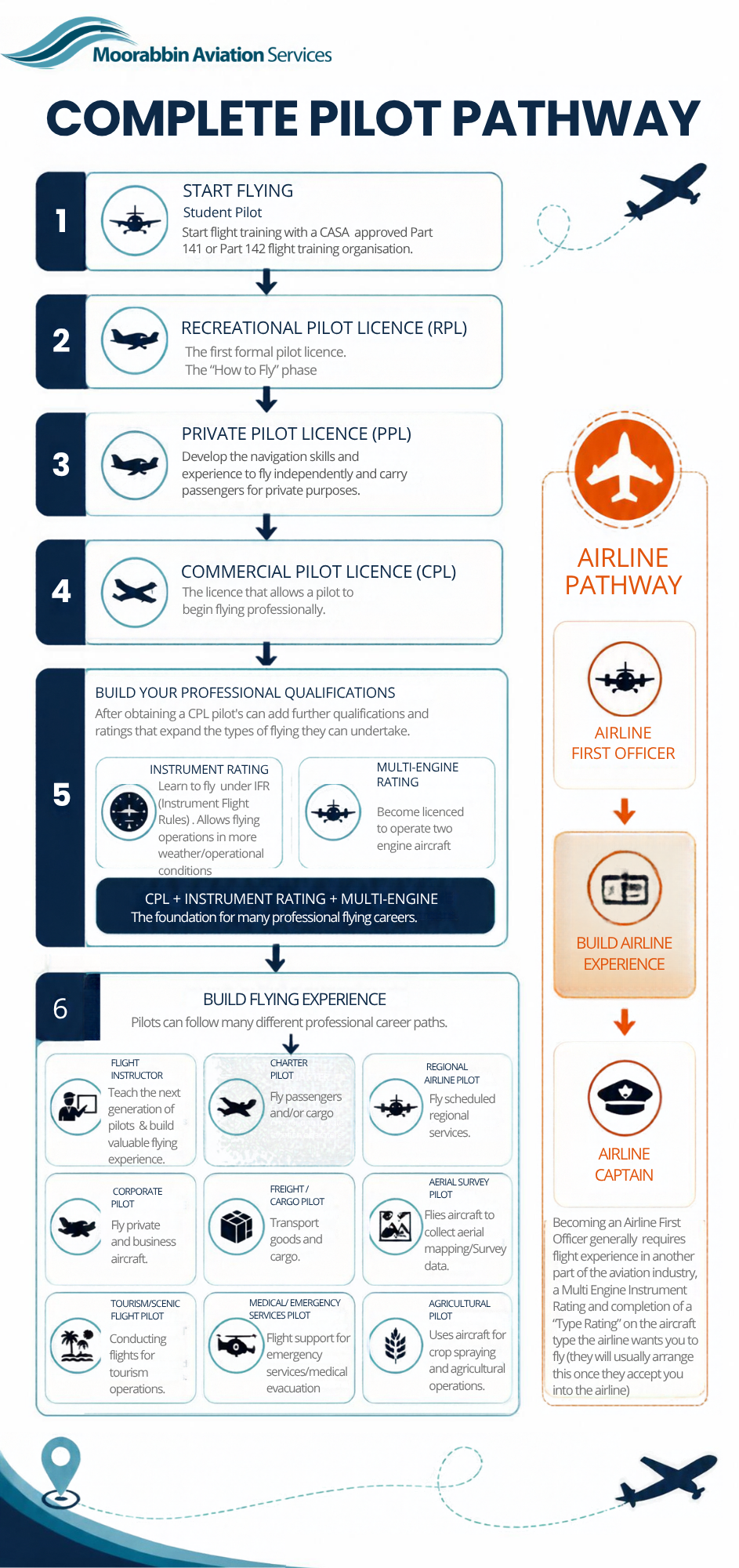
For someone starting with little or no flying experience, the pathway broadly looks like this:
- Explore the career
- Check the basic requirements
- Complete an aviation medical
- Learn to fly — RPL
- Learn to navigate — PPL
- Qualify to fly professionally — CPL
- Add further qualifications — Instrument Rating & Multi-Engine / Instructor Rating / Type Ratings
- Build professional flying experience
- Progress towards your career goal
For some pilots this may eventually mean an airline cockpit. For others it may mean charter, corporate, instructional, helicopter or another form of professional flying.
Step 1 — Explore the Career
Before spending money on flight training, take some time to understand what being a professional pilot actually involves.
Pilot training requires:
- Commitment
- Study
- Practical flying skills
- Discipline
- Financial investment
- Ongoing assessment
- A strong approach to safety
Professional pilots also work in a range of environments and may have irregular working hours, travel requirements and significant responsibility.
That's why understanding the career before you start training is important.
Step 2 — Check the Basic Requirements
There are a number of requirements to consider before beginning a professional pilot pathway.
These can include:
- Age requirements
- English language ability
- Education
- Aviation medical requirements
- Ability to meet the relevant licensing standards
- Financial capacity to complete the training
The requirements can vary depending on the licence, training organisation and career pathway.
Aviation regulations also change, so always check the current requirements with the relevant Australian authorities and your chosen training organisation.
Step 3 — Complete Your Aviation Medical
Aviation medical requirements are an important part of becoming a professional pilot.
For someone intending to pursue a professional flying career, it makes sense to investigate medical eligibility before committing significant money to training.
Your medical assessment is conducted by a CASA approved aviation medical examiner who considers your health against the applicable aviation medical standards.
Don't leave the medical until you've already invested heavily in your training.
Step 4 — Learn to Fly: The Recreational Pilot Licence
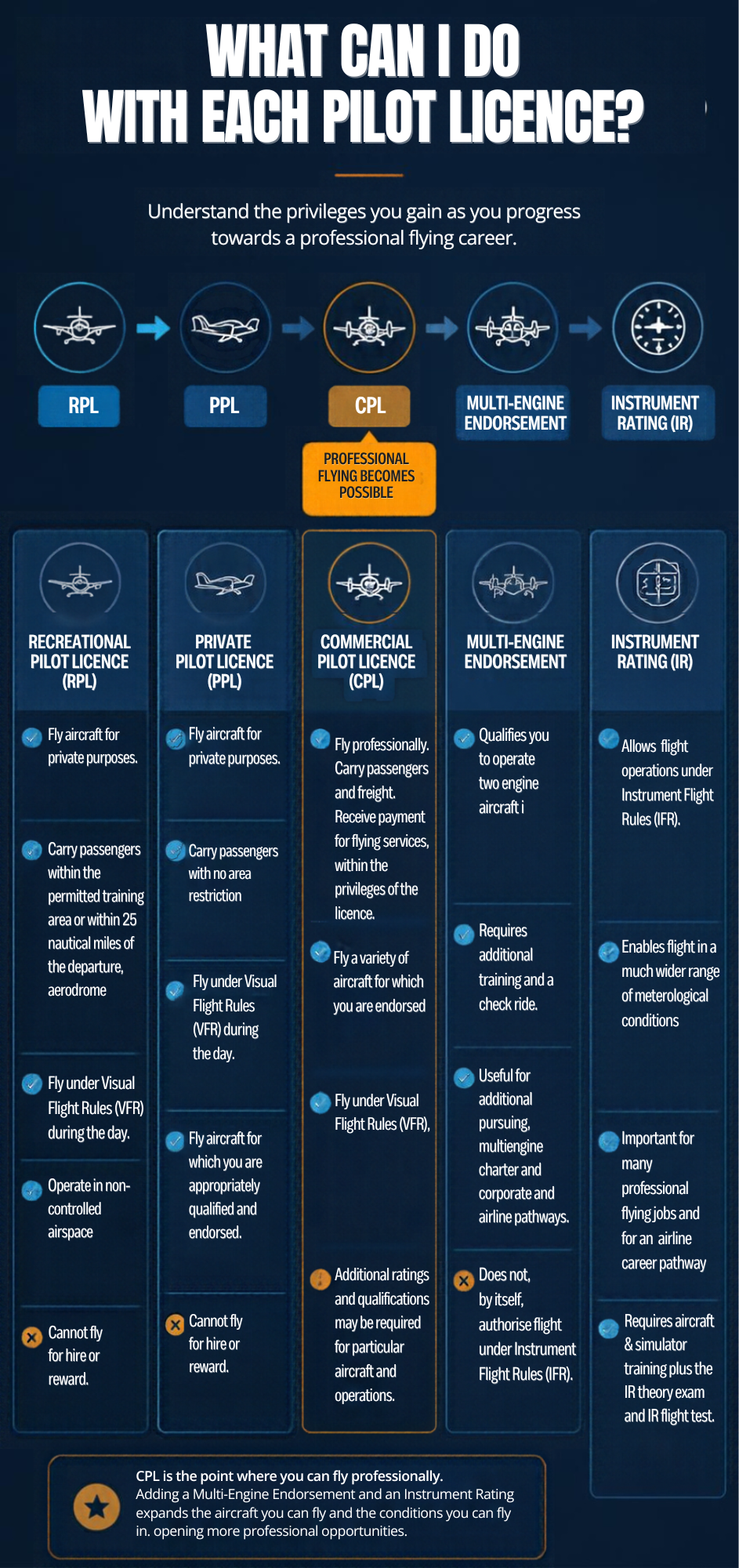
For someone who has never flown before, the Recreational Pilot Licence (RPL) is where the practical skills of flying begin.
The early training teaches you how to control an aircraft and fly it safely.
You'll learn fundamental skills such as:
- Straight and level flight
- Climbing and descending
- Turning
- Take-offs
- Landings
- Aircraft control
- Radio communication
- Basic flight procedures
- Emergency procedures
How much flying?
The minimum flight training requirement for an RPL is 25 hours. However, minimum hours are not necessarily a realistic indication of how long it will take an individual student.
For planning purposes, around 40 hours is a more realistic expectation for many students, including approximately:
- 35 hours dual — flying with an instructor
- 5 hours solo — flying alone after being authorised by your instructor
Assessment
Pilot training isn't simply a matter of completing a certain number of hours.
At each major stage, you need to demonstrate both your theoretical knowledge and practical flying skills.
For the RPL, this includes the required CASA RPL theory exam and a practical flight test with a CASA-approved flight examiner.
The RPL is an important first stage because it develops the fundamental flying skills on which all later pilot training is built.
However, an RPL is a recreational licence. It does not qualify you to work as a professional pilot or receive payment for flying.
Step 5 — Learn to Navigate: The Private Pilot Licence
The Private Pilot Licence (PPL) builds on the basic flying skills developed during RPL training and introduces the navigation skills required to fly an aircraft from one place to another.
You learn how to plan and conduct longer flights using Visual Flight Rules (VFR), including:
- Flight planning
- Navigation
- Reading aviation charts
- Weather assessment
- Radio procedures
- Airspace requirements
- Diversions
- Managing the flight while navigating
How much flying?
For an average student, approximately another 25 hours of flying may be required for the PPL navigation training, including approximately:
- 20 hours dual — navigation training with an instructor
- 5 hours solo — solo navigation
The actual hours required will vary according to the student's progress and the training program.
Assessment
As with the RPL, the PPL involves both theoretical knowledge assessment bu means of the CASA exam and a practical flight test with a CASA-approved flight examiner.
A PPL allows you to fly privately, including taking friends or family with you, within the privileges and limitations of the licence.
However, a PPL is still a private licence. You cannot be paid to fly.
If your goal is to become a professional pilot, you need to progress to the Commercial Pilot Licence (CPL).
Step 6 — Qualify to Fly Professionally: The CPL
The Commercial Pilot Licence (CPL) is the minimum pilot licence required to work as a professional pilot and receive payment for flying, subject to the appropriate ratings, endorsements and operating requirements.
CPL training takes your flying and aviation knowledge to a professional standard.
It includes both flight training and extensive theoretical study.
How much flying?
CASA specifies minimum experience requirements for the CPL. For the aeroplane CPL pathway, this includes a minimum of 150 hours total flight time, including at least 70 hours as pilot in command.
However, minimum hours should not be confused with the amount of training an average student is likely to require.
For planning purposes, around 170 total flying hours is a more realistic expectation for many students by the time they complete their CPL training.
The CPL theory examinations
To obtain a CPL, you need to pass the required CASA examinations:
| 1. | Air Law |
|---|---|
| 2. | Navigation |
| 3. | Meteorology |
| 4. | Aerodynamics |
| 5. | Aircraft General Knowledge |
| 6. | Human Factors |
| 7. | Operations, Performance and Flight Planning |
You will also need to demonstrate the required flying competency in the CPL flight test with a CASA-approved flight examiner.
The CPL is much more than simply being able to control an aircraft. It requires a professional level of flying skill, knowledge, decision-making and understanding of aviation operations.
This is the qualification that takes you from private flying into professional flying.
It is the minimum pilot licence required to work as a professional pilot and be paid for flying.
Step 7 — Add Further Qualifications
A CPL is the minimum licence for professional flying, but it is generally not the end of the training required for the type of career most aspiring professional pilots want.
Two particularly important additions are an Instrument Rating and Multi-Engine training.
Instrument Rating
An Instrument Rating (IR) provides the skills and privileges required to operate under Instrument Flight Rules (IFR).
Instrument flying is an essential part of modern professional aviation and is particularly important for pilots intending to pursue airline, regional and many other commercial flying careers.
How much training?
A typical IR training program may involve approximately:
- 22 hours of simulator training
- 22 hours of flight training
- 3 hours for the practical flight test
The actual training required can vary between students.
The IR also involves the required theoretical examination/s and a practical flight test with a CASA-approved flight examiner.
Multi-Engine Endorsement
A Multi-Engine Endorsement allows a pilot to operate aircraft with more than one engine.
Multi-engine experience is an important part of the pathway for pilots intending to progress into larger and more sophisticated commercial aircraft, including airline operations.
How much training?
A typical multi-engine endorsement may involve approximately 8 hours of flight training, although the actual amount will depend on the student's progress and the aircraft and training program.
The appropriate practical assessment must also be completed.
The exact combination of ratings, endorsements and additional qualifications required will depend on your intended career.
How Can You Complete Your Pilot Training?
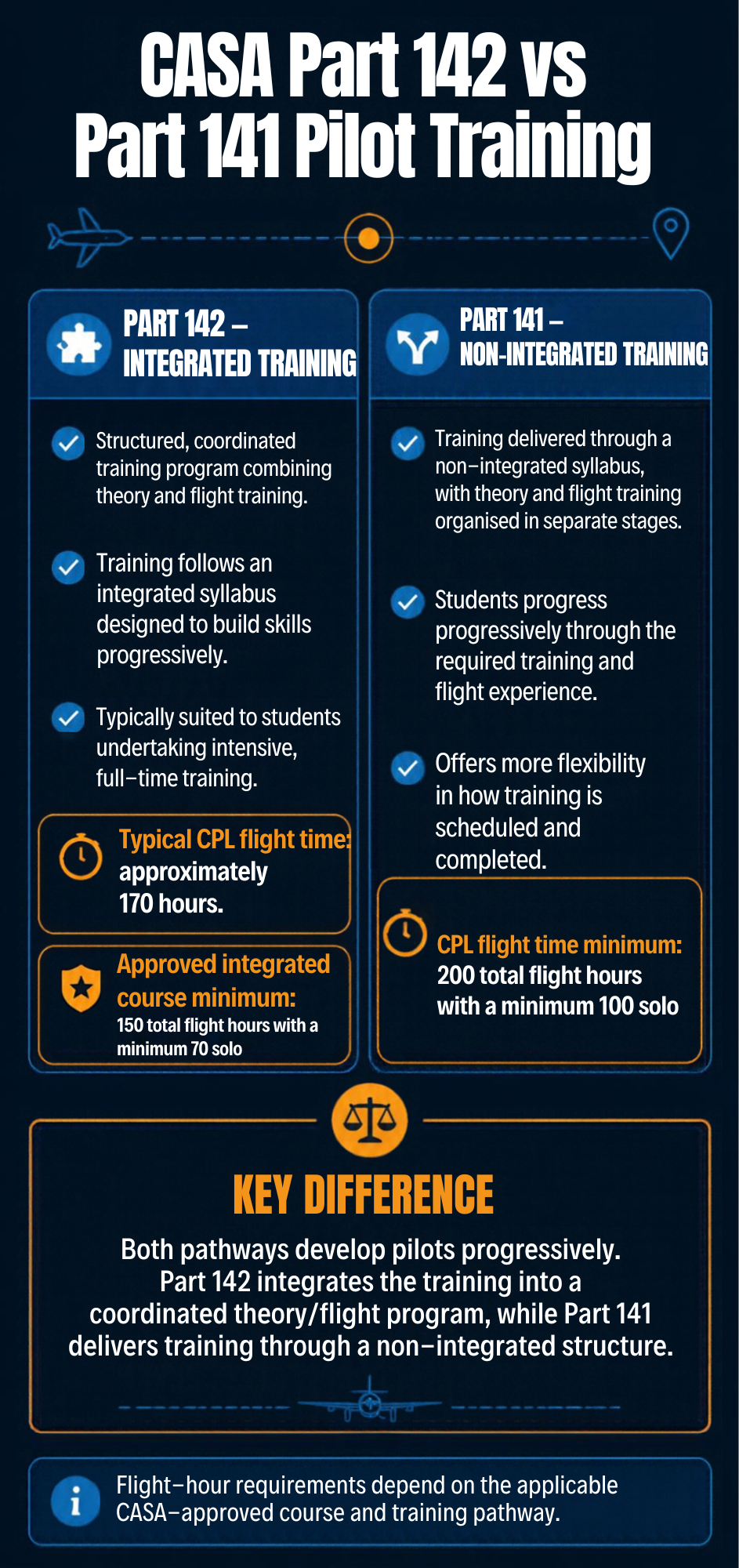
There are two broad approaches to completing professional pilot training in Australia.
Integrated Training — CASA Part 142
Most students who want to undertake professional pilot training as a structured full-time program will undertake an integrated course under CASA Part 142.
An integrated program brings the different stages of training together into a structured course, providing a planned pathway from the beginning of training through to the required professional qualifications.
This can be particularly suitable for students who want to train full-time and follow a clearly structured program.
Non-Integrated Training — CASA Part 141
Students who want greater flexibility can undertake non-integrated training under CASA Part 141.
This allows training to be completed progressively rather than as one integrated course.
It can suit people who want to train part-time, work while they study, or have greater flexibility over the pace and sequence of their training.
Both pathways can lead to professional pilot qualifications. The choice is largely about the way you want to undertake your training.
Do You Need a University Degree?
No. A university degree is not a requirement to become a professional pilot or an airline pilot in Australia.
Some students choose to undertake a university degree alongside their pilot training. This can provide an additional academic qualification and may have value for some individuals.
However, it involves additional time and expense and does not automatically make someone a better candidate for an airline job.
Airlines are primarily looking for pilots who have the appropriate qualifications and flying experience, together with the personal attributes required to operate safely and effectively as a professional pilot.
These include qualities such as:
- Good communication
- Teamwork
- Sound judgement
- Professionalism
- Situational awareness
- Decision-making
- A strong safety attitude
- The ability to learn and perform consistently
A university degree may therefore be a personal choice rather than a necessary step in becoming an airline pilot.
Step 8 — Build Professional Flying Experience
Once you have your CPL and the qualifications appropriate to your career goal, the next challenge is building professional flying experience.
A new commercial pilot may begin their career in roles such as:
- Flight instruction
- Charter flying
- Regional aviation
- Aerial work
- Other commercial operations
For pilots who ultimately want to fly for an airline, building experience is an important part of progressing towards that goal.
As your experience and qualifications develop, you can become eligible for progressively more advanced flying opportunities.
Step 9 — Progress Towards Your Career Goal
There is no single career destination for every professional pilot.
Depending on your interests, qualifications and experience, your career could develop into:
- Airline flying
- Regional aviation
- Charter
- Corporate aviation
- Flight instruction
- Specialist flying
- Helicopter operations
For those pursuing an airline career, the pathway generally involves progressively developing flight experience, instrument and multi-engine experience, additional qualifications and operational experience.
Airline recruitment requirements vary between airlines and can change over time.
Having a CPL does not guarantee an airline position. Airlines consider qualifications, experience, competency and personal attributes when recruiting pilots.
How Long Does It Take?
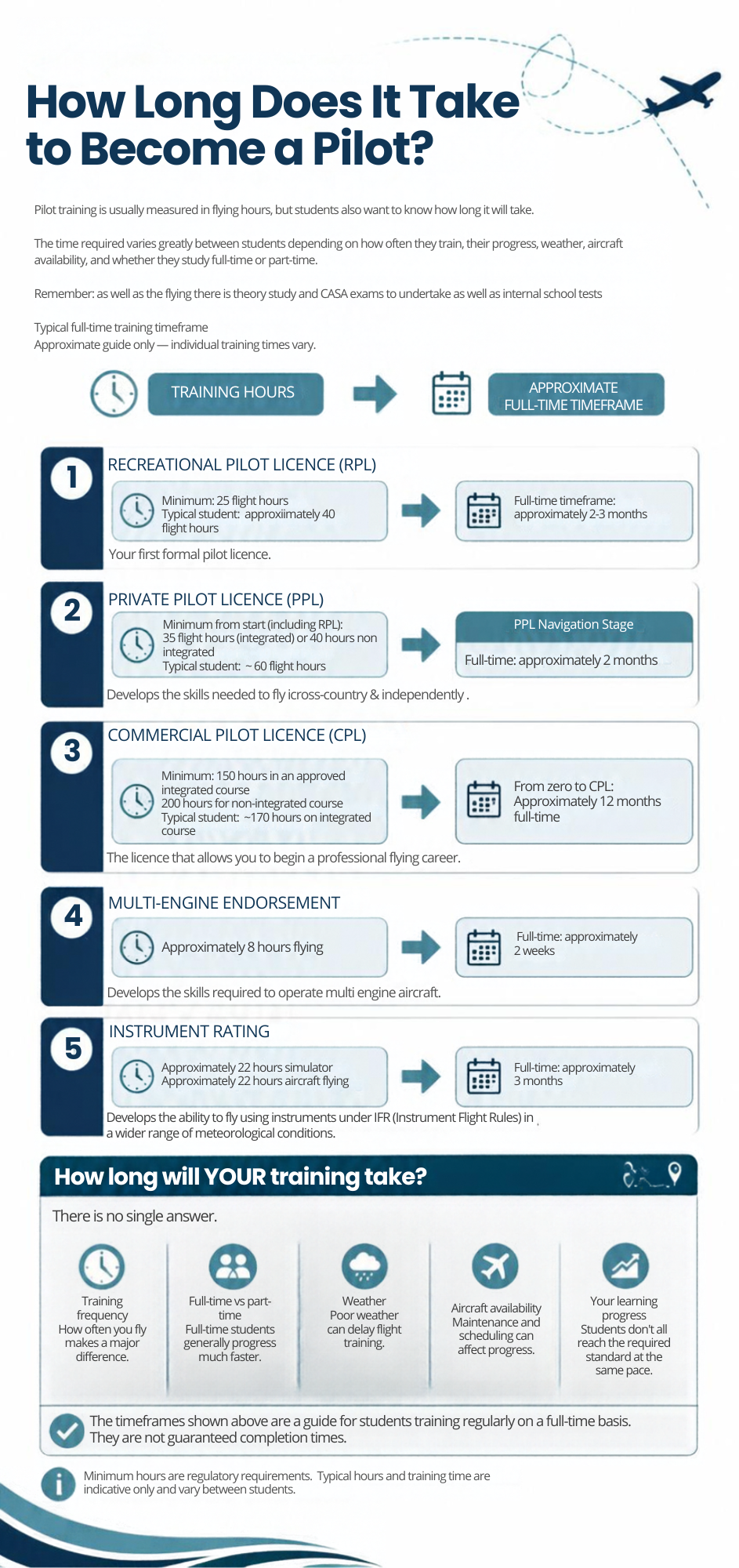
There is no single answer.
The time required depends on:
- Your training pathway
- How frequently you fly
- Weather and aircraft availability
- Your progress through training
- Study requirements
- Whether you train full-time or part-time
- Additional qualifications
- Your financial circumstances
A student undertaking structured full-time training may progress differently from someone completing modular training while working.
For reference, if you work hard and study full time, its possible to go from zero to CPL within 12 months.
Ready to Explore Your Pilot Path?
Before committing to pilot training, take the time to understand the training, costs, qualifications and realities of becoming a professional pilot.
Explore your possibilities
Your pilot pathway
Use these stages to organise your research and conversations.
Understand requirements
Ask about entry requirements and the qualifications relevant to your goals.
Explore Understand requirementsChoose a training pathway
Compare the structure, time commitment and costs of your options.
Explore Choose a training pathwayBegin training
Build knowledge and practical skills with a training provider.
Explore Begin trainingBuild experience
Keep developing your skills and explore the next stages of your pathway.
Explore Build experienceStart an aviation career
Explore opportunities that match your qualifications, experience and goals.
Explore Start an aviation careerYour next step
See the possibilities in person.
Continue your PilotPath
Training & Qualifications
Make sense of the questions to ask when comparing pilot training pathways.
Explore Training & QualificationsThe Pilot Reality Check — What Is Being a Pilot Really Like?
Look at the whole picture before committing to pilot training.
Explore The Pilot Reality Check — What Is Being a Pilot Really Like?Pilot Fit Check
A few questions. A useful next step. Find where to take your curiosity next.
Explore Pilot Fit Check