PilotPath / Aviation careers
Career Pathways
Explore how training, experience and opportunities can connect over time.
Becoming an airline pilot is only one option
Many people who start flight training dream of eventually flying an airliner with Qantas, Jetstar or Virgin.
That is certainly one possible career path — but it is not the only one.
Professional pilots work in many different areas of aviation, and some pilots find that charter, corporate, instructional, tourism, aerial survey or specialist flying suits them better than an airline career.
The important thing is to understand that professional flying is usually a progression.
You don't normally finish your CPL and immediately move into a large aircraft.
Where do pilots build their hours?
Two of the most common ways for new commercial pilots to build experience are:
Flight Instructor
A pilot with an Instructor Rating can teach other students to fly.
This is a very common first professional flying job because the pilot can build significant flight experience while developing teaching, communication and decision-making skills.
An Instructor Rating can be undertaken after obtaining a CPL and does not necessarily require an Instrument Rating first.
Charter and Tourism Flying
Another common pathway is working for a charter or tourism operator.
Examples include:
- Scenic flights
- Island transfers
- Tourist flights
- Passenger charter
- Remote-area operations
- Small regional services
These jobs provide experience carrying passengers and operating in real commercial environments.
Airline Pilot
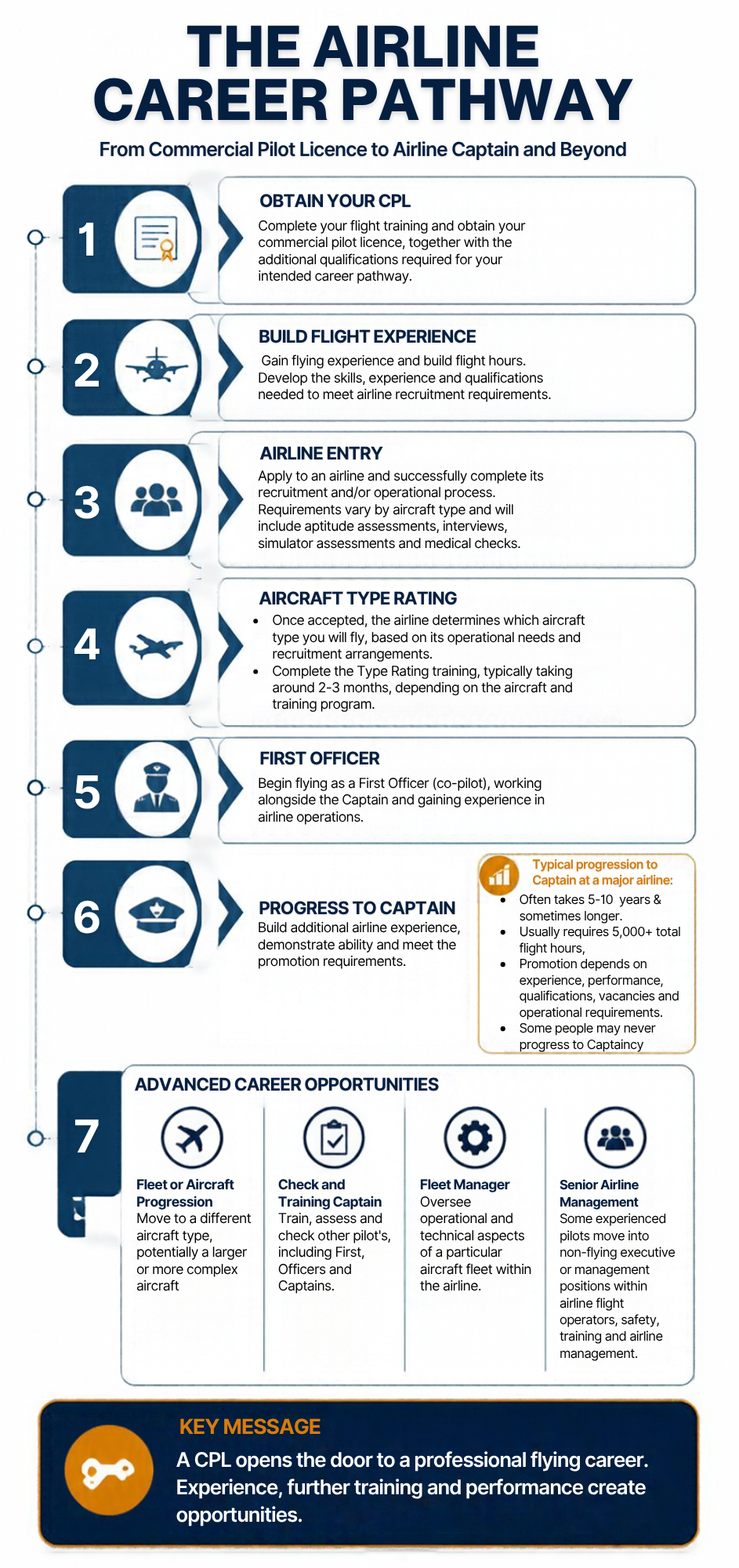
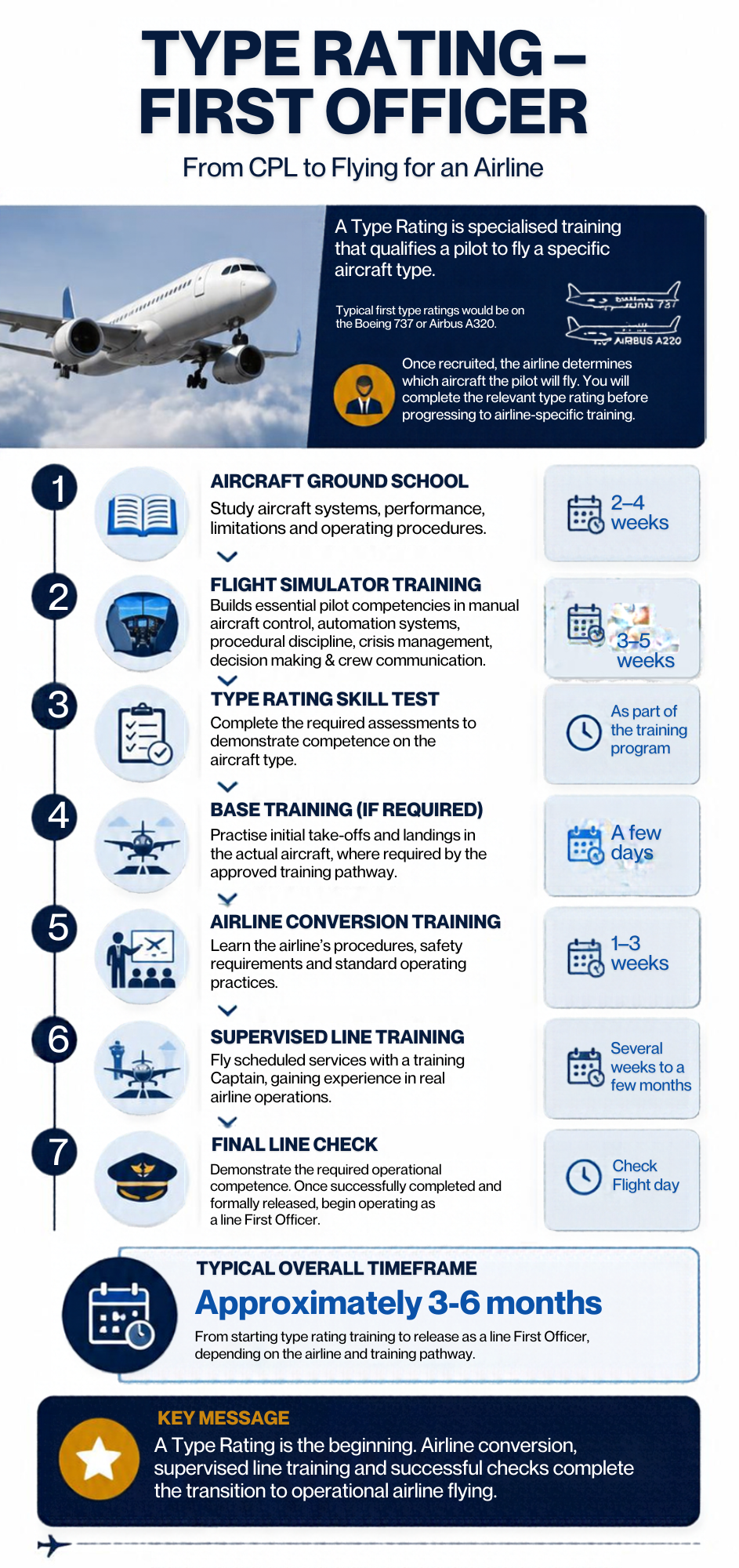
The airline pathway is one of the most visible career options.
A typical progression might be:
- CPL + additional qualifications
- Build experience
- Airline recruitment
- Airline-specific training
- Type Rating
- First Officer
- Build substantial experience
- Captain
Airline pilots operate highly sophisticated aircraft and work within highly structured multi-crew environments.
Competition for airline positions can be significant, and airlines set their own recruitment, experience and training requirements.
Flight Instructor
Flight instruction can be both a first job and a long-term career.
Instructors teach students from their first flight through to advanced licences and ratings.
Experienced instructors can progress into:
- Senior instructor roles
- Chief Flying Instructor positions
- Flight training management
- Examiner roles
- Specialist training
Some instructors eventually move to airlines or other professional flying, while others build a long-term career in flight training.
Charter & Regional Pilot
Charter flying covers a huge range of operations.
Pilots may fly:
- Tourists
- Business travellers
- Remote communities
- Workers
- Medical passengers
- Freight
- Private groups
Aircraft range from small single-engine aircraft through to sophisticated multi-engine aircraft.
Charter flying can provide excellent experience because pilots may operate from smaller airports and deal with a wide variety of weather, terrain, aircraft and operational situations.
Corporate Pilot
Corporate pilots fly private or company aircraft for businesses and high-net-worth individuals.
Aircraft can range from smaller turboprops to sophisticated business jets.
Corporate flying can involve:
- International travel
- Short-notice trips
- VIP passengers
- Complex aircraft
- IFR operations
- International procedures
The qualifications and experience required vary considerably depending on the aircraft and operator.
Flying Doctor / Medical Aviation / Medical Evacuation
Australia's large distances create a need for specialist aviation services supporting remote and regional communities.
Organisations such as the Royal Flying Doctor Service operate aircraft for medical transport and related operations.
These are generally advanced professional flying positions and require significant experience and appropriate qualifications.
Pilots may operate sophisticated multi-engine aircraft, often in challenging environments and under IFR.
Seaplane Pilot
Seaplane flying is a specialist career found in parts of Australia and internationally.
Seaplane pilots may operate:
- Scenic flights
- Island transfers
- Resort services
- Charter flights
- Remote-area operations
It requires additional training and experience because operating from water presents different considerations from normal runway operations.
Aerial Survey & Mapping
Aircraft are also used for:
- Aerial photography
- Mapping
- Surveying
- Geographical data collection
- Infrastructure inspection
- Environmental monitoring
These operations can involve specialised aircraft, equipment and flight profiles.
Agricultural Aviation
Agricultural pilots operate aircraft for purposes such as:
- Crop spraying
- Seeding
- Pest control
- Agricultural surveying
This is highly specialised flying and requires additional training, experience and approvals.
It is generally not an entry-level flying job.
Other Professional Flying Careers
There are many other opportunities in aviation, including:
- Aerial photography
- Firefighting
- Search and rescue
- Police aviation
- Coastwatch and maritime surveillance
- Customs and border protection
- Pipeline and powerline inspection
- Helicopter operations
- Glider towing
- Banner towing
- Parachute operations
- Remote-area flying
- Aircraft ferrying
•
Some of these careers require significant additional training, specialised licences, ratings or operational experience.
There Is No Single "Pilot Career"
The aviation industry needs pilots with many different skills.
Some pilots want to fly airliners.
Others would rather:
- Fly tourists around Australia's coastline
- Teach the next generation of pilots
- Fly a corporate jet
- Operate in remote Australia
- Fly a seaplane
- Conduct aerial surveys
- Support medical services
- Work in specialist aviation
There is no requirement to follow the airline pathway simply because you have obtained a CPL.
The important thing is to understand the progression:
- Learn to fly
- Obtain your licences
- Get your first flying job
- Build experience
- Develop additional skills and qualifications
- Progress into the type of flying that suits your interests and career goals
A CPL gives you the opportunity to start a professional flying career. It does not determine what that career has to look like.
Explore your possibilities
Map your next steps
Build a plan you can review as you learn more.
Understand requirements
Ask about entry requirements and the qualifications relevant to your goals.
Explore Understand requirementsChoose a training pathway
Compare the structure, time commitment and costs of your options.
Explore Choose a training pathwayBegin training
Build knowledge and practical skills with a training provider.
Explore Begin trainingBuild experience
Keep developing your skills and explore the next stages of your pathway.
Explore Build experienceStart an aviation career
Explore opportunities that match your qualifications, experience and goals.
Explore Start an aviation careerYour next step
See the possibilities in person.
Continue your PilotPath
Training & Qualifications
Make sense of the questions to ask when comparing pilot training pathways.
Explore Training & QualificationsThe Pilot Reality Check — What Is Being a Pilot Really Like?
Look at the whole picture before committing to pilot training.
Explore The Pilot Reality Check — What Is Being a Pilot Really Like?Pilot Fit Check
A few questions. A useful next step. Find where to take your curiosity next.
Explore Pilot Fit Check