Training & Qualifications
Make sense of the questions to ask when comparing pilot training pathways.
Explore Training & QualificationsPilotPath / Aviation careers
Explore how your interests today could connect to a future in aviation.
Thinking about becoming a pilot after school?
If you're finishing school and thinking about becoming a professional pilot, you are already at a good stage to start exploring the career.
You don't need to have everything worked out yet.
Pilot training is a journey, and starting when you're young gives you more time to learn, gain experience and develop towards your long-term career goals.
For some people, that may eventually mean flying for an airline. For others, it may lead to charter, corporate, regional, instructional or other professional flying.
The important thing is to start by understanding what is involved.
You can start learning to fly while you are still at school.
There is no need to wait until you have finished Year 12 before taking your first flying lesson.
Learning to fly at a young age can be a great way to discover whether you enjoy flying and whether you can see yourself pursuing it as a career.
You can progressively build your flying skills and qualifications as you get older.
CASA Pilot Licence Age Requirements
| Licence / Qualification | Minimum Age |
|---|---|
| Start flight training | No minimum age specified by CASA* |
| Recreational Pilot Licence (RPL) | 16 years |
| Private Pilot Licence (PPL) | 17 years |
| Commercial Pilot Licence (CPL) | 18 years |
A student must be able to meet the relevant requirements for the training being undertaken, and individual flight training organisations may have their own minimum age policies.
These age requirements are subject to the current CASA regulations and should be confirmed before commencing training.
This means that a student who starts learning to fly during their later school years can potentially progress through their initial training and be ready to begin a professional flying career relatively early.
One of the biggest advantages of starting your pilot journey early is time.
Professional flying careers are built through a combination of:
Qualifications + Flying Experience + Skills + Professional Development
The earlier you begin, the more time you have to develop each of these.
For someone who ultimately wants to pursue an airline career, starting early can provide more time to:
Starting early doesn't guarantee a particular career outcome — but it gives you more time to develop towards your goals.
There are no minimum educational qualifications required to train as a pilot.
You don't need a university degree or a particular school qualification simply to begin pilot training.
However, a good general education is an advantage.
Pilot training involves studying subjects such as:
The most important qualities are your willingness to learn, your commitment to study and your ability to apply what you learn.
Not necessarily.
You do not need to be a top-level mathematics or physics student to become a pilot.
However, these subjects can provide a useful foundation because pilots need to understand concepts involving:
If you enjoy maths and physics, that's certainly helpful — but don't assume that not studying advanced maths or physics means you cannot become a pilot.
If becoming a pilot interests you, there are several useful things you can do before you finish school.
1. Go flying
Take an introductory flying lesson and experience what it is actually like to control an aircraft.
2. Learn about the career
Talk to pilots, instructors and flying schools. Find out what the job is really like rather than relying only on what you see online.
3. Look after your education
You don't need perfect grades, but developing good study habits and completing school with a solid general education will help you throughout your career.
4. Look after your health and fitness
Professional pilots have aviation medical requirements, so it is sensible to understand these early.
5. Start thinking about the financial commitment
Pilot training is a significant investment. Understanding the costs and available options early gives you and your family more time to plan.
6. Take the Pilot Fit Check
Use our Pilot Fit Check to think about whether the lifestyle, commitment and responsibilities of professional flying are right for you.
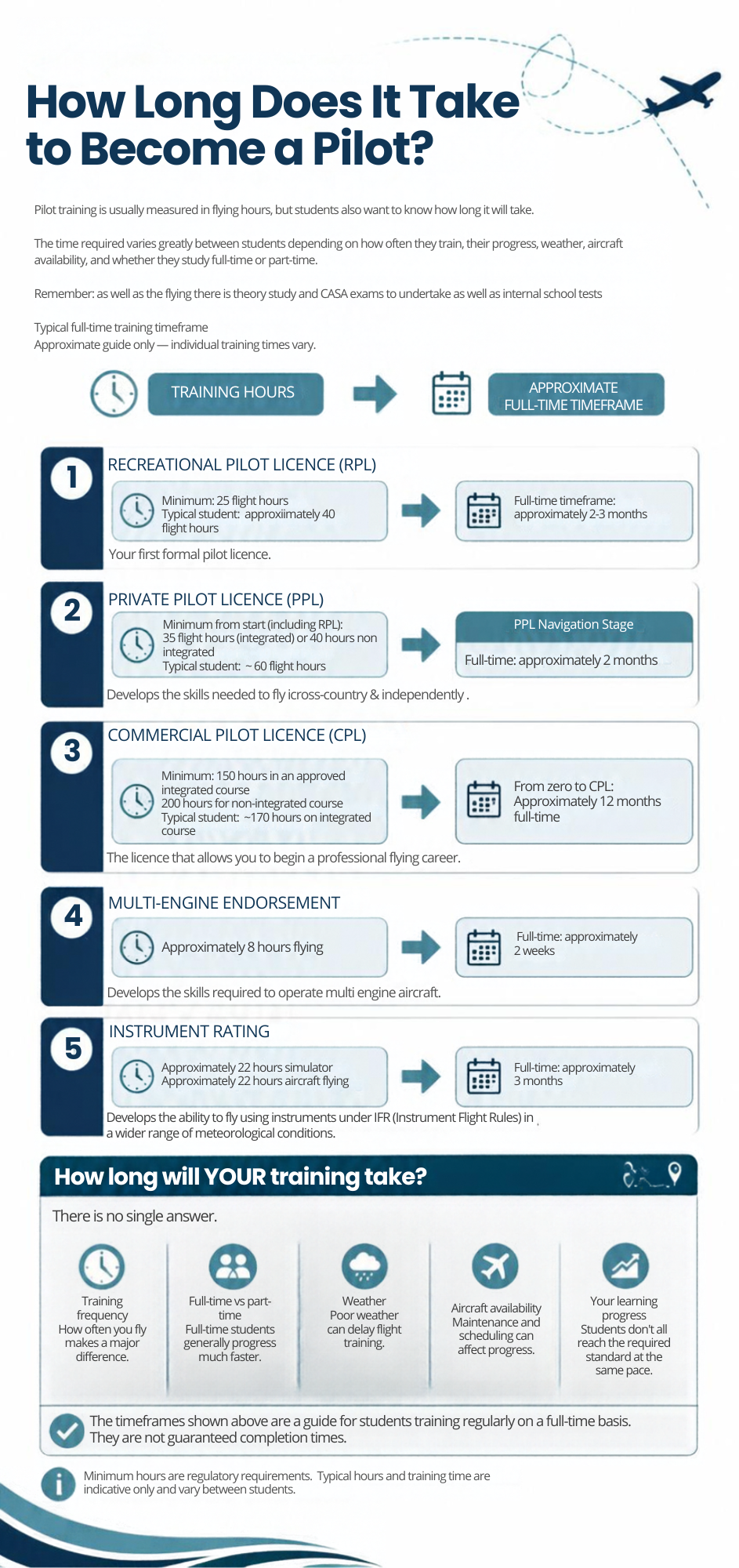
A school leaver might follow a pathway such as:
The actual pathway and timing will vary from person to person.
Some students train full-time after school through a structured professional program.
Others begin learning to fly while they are still at school and complete their training progressively.
There is no single timetable that suits everyone.
If your long-term goal is to fly for an airline, you don't need to become an airline pilot immediately.
The early part of your career is about building the qualifications, experience and professional skills that can eventually allow you to compete for more advanced flying opportunities.
Airlines do not simply look at your age or where you trained.
They are interested in whether you have the appropriate qualifications and experience and whether you demonstrate the personal attributes required of a professional airline pilot.
Starting young gives you more time to develop those things.
One of the advantages of starting early is that you can explore the career before making a major commitment.
You might discover that you love flying and want to pursue it professionally.
You might decide that you want to become an airline pilot.
Or you might discover another type of flying that interests you more.
You can start learning to fly at almost any stage of life. Starting young simply gives you more time to explore, learn and build experience.
Ready to take the next step?
If becoming a pilot is something you're seriously considering, start by understanding the pathway and what will be expected of you.
Your next step
Make sense of the questions to ask when comparing pilot training pathways.
Explore Training & Qualifications