
Ever looked inside a small aircraft cockpit and wondered what all those round dials actually do? For someone considering becoming a pilot, the instrument panel can initially look complicated. There are needles, numbers, coloured markings and gauges that each tell the pilot something important about the aircraft.
The good news is that the instruments have specific purposes, and learning to interpret them is one of the first steps in flight training.
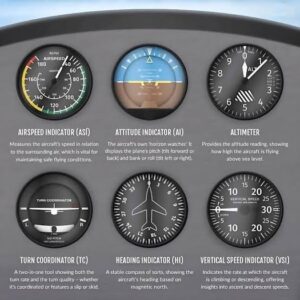
In many traditional training aircraft, including Piper PA-28 variants, pilots learn using analogue flight instruments, individual round dials with physical needles rather than a large digital display. Six of these instruments form a familiar group known as the six-pack.
In this guide, we’ll explain what each instrument does, how the instruments work together, and what else you’ll find in a typical training aircraft cockpit.
The six-pack: Six essential flight instruments
The six-pack is the traditional arrangement of six primary flight instruments used to help pilots understand the aircraft’s movement, speed, altitude and direction.
In a conventional layout, the instruments are arranged in two rows of three. The exact arrangement can vary between aircraft, but the six instruments provide the same essential information.
1. Airspeed Indicator — How fast are we flying?
The airspeed indicator tells the pilot how fast the aircraft is moving through the air. It is usually marked in knots.
Unlike a car’s speedometer, which measures speed over the ground, an aircraft’s airspeed indicator measures speed using air pressure. This distinction matters because wind can cause the aircraft’s speed over the ground to differ significantly from its speed through the air.
Pilots use airspeed to help manage different phases of flight, including take-off, climb, cruise, approach and landing.
On many conventional aircraft, the dial also has coloured arcs that indicate important operating speed ranges. These markings help the pilot recognise relevant speed limitations and operating ranges for that particular aircraft.
Why it matters: Flying too slowly can lead to a stall if the critical angle of attack is exceeded, while exceeding the aircraft’s permitted speed limits can create other hazards.
2. Attitude Indicator — What is the aircraft’s position relative to the horizon?
The attitude indicator, sometimes called the artificial horizon, shows the aircraft’s pitch and bank relative to the horizon.
The display typically uses blue to represent the sky and brown to represent the ground, with a small aircraft symbol in the centre.
- Pitch: Whether the aircraft’s nose is pointing up or down.
- Bank: Whether the aircraft is tilted to the left or right.
The instrument helps pilots maintain straight-and-level flight and establish the correct attitude for climbs, descents and turns.
For example, if a student pilot is learning to maintain level flight, the attitude indicator provides a useful visual reference for keeping the aircraft’s wings level and its nose at the appropriate position.
Why it matters: It helps the pilot understand the aircraft’s orientation, especially when the natural horizon is difficult to see.
3. Altimeter — How high are we flying?
The altimeter indicates the aircraft’s altitude, normally in feet in Australian general aviation.
It works by measuring changes in atmospheric pressure. As the aircraft climbs, outside air pressure generally decreases; as it descends, pressure generally increases.
The pilot must set the altimeter’s pressure reference correctly to obtain the intended altitude indication. This is particularly important when operating near other aircraft, terrain or controlled airspace.
For example, a pilot might be instructed to maintain 3,000 feet during a training exercise. The altimeter helps monitor whether the aircraft is holding that altitude.
Why it matters: Maintaining the correct altitude is essential for separation from terrain, compliance with airspace requirements and safe coordination with other aircraft.
4. Turn Coordinator — Is the aircraft turning correctly?
The turn coordinator gives the pilot information about the aircraft’s rate of turn and initial rolling movement. It also includes a small curved tube containing a ball, which helps indicate whether the turn is coordinated.
When an aircraft turns, the pilot aims to coordinate the aircraft’s banking and yawing movements rather than allowing it to slip or skid through the turn.
The ball provides a simple visual reference:
- Ball centred: The turn is coordinated.
- Ball displaced to one side: The aircraft is slipping or skidding, and the pilot may need to correct the coordination.
The turn coordinator is particularly useful when learning to make smooth, balanced turns.
Some aircraft instead use a turn-and-slip indicator, which displays turn rate and coordination but differs in how the instrument responds to aircraft movement.
Why it matters: Properly coordinated turns improve control and help students develop accurate flying technique.
5. Heading Indicator — Which direction are we pointing?
The heading indicator shows the direction in which the aircraft’s nose is pointing, using a compass-style scale marked in degrees from 000 to 360.
For example:
- 000° represents north.
- 090° represents east.
- 180° represents south.
- 270° represents west.
The heading indicator makes it easier to maintain a selected heading and monitor changes during turns.
Traditional heading indicators use a gyroscopic reference and must be checked and aligned with the magnetic compass as required. Depending on the instrument, they can also be affected by drift or other errors.
Why it matters: Maintaining the correct heading is important for navigation, following instructions and flying a planned route.
6. Vertical Speed Indicator (VSI) — Are we climbing or descending?
The vertical speed indicator shows how quickly the aircraft is climbing or descending, usually in feet per minute.
A reading of zero indicates that the instrument is showing no vertical rate. A positive reading indicates a climb, while a negative reading indicates a descent.
For example, a student pilot might use the VSI to monitor a climb at 500 feet per minute or to establish a steady descent during a training exercise.
The VSI responds to changes in atmospheric pressure and typically has a slight lag, so it is used alongside other flight instruments rather than in isolation.
Why it matters: It helps pilots monitor climbs and descents and make smoother transitions between different phases of flight.
How do the six instruments work together?
A pilot does not simply look at one gauge at a time. Instead, the pilot develops the habit of scanning several instruments and combining the information they provide.
Imagine you are learning to maintain straight-and-level flight.
You would use the attitude indicator to monitor the aircraft’s pitch and bank, the altimeter to check your altitude, the airspeed indicator to monitor speed, and the VSI to identify any developing climb or descent. The heading indicator helps you maintain direction, while the turn coordinator helps you monitor turns and coordination.
Each instrument contributes a different piece of information.
This is why flight training involves learning not only what each instrument does, but also how to interpret the instruments together and recognise when their indications do not agree.
What other instruments and gauges are in a training aircraft?
The six-pack is only part of the instrument panel. A typical Piper PA-28 training aircraft also has instruments and controls that help the pilot monitor the engine, electrical system, fuel and navigation equipment.
The exact equipment depends on the aircraft model and how it is configured.
Engine instruments
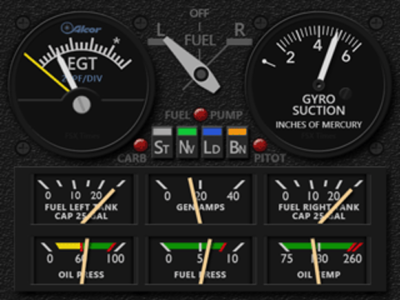
These instruments help the pilot monitor the engine’s operation.
Tachometer (RPM gauge)
Shows the engine’s rotational speed in revolutions per minute (RPM). Pilots use it to monitor engine power settings.
Oil pressure gauge
Indicates the engine’s oil pressure. An abnormal reading can signal a problem requiring prompt attention.
Oil temperature gauge
Shows the temperature of the engine oil, helping the pilot monitor engine operating conditions.
Fuel quantity indicators
Show the fuel quantity indicated in the aircraft’s tanks. Pilots also calculate fuel requirements and monitor consumption rather than relying on the gauges alone.
Electrical system indicators
Depending on the aircraft, these may include an ammeter or an indication of electrical system voltage. They help the pilot monitor the aircraft’s electrical supply and charging system.
Some PA-28 variants also have additional engine instruments, such as a cylinder head temperature gauge or fuel pressure gauge.
Magnetic compass
The magnetic compass provides a reference for the aircraft’s magnetic heading. It is especially useful for checking the heading indicator and as a backup heading reference.
Unlike the heading indicator, a traditional magnetic compass does not depend on a powered gyroscope. However, it has characteristic errors during acceleration and turns, so pilots learn to interpret it correctly.
Navigation instruments and GPS
Many training aircraft have additional navigation equipment.
Depending on the aircraft, this may include a VHF navigation receiver, a course deviation indicator, GPS equipment or a moving-map display.
These systems help pilots determine their position, follow a planned route and navigate to a destination. The precise equipment varies between aircraft.
Radio and transponder
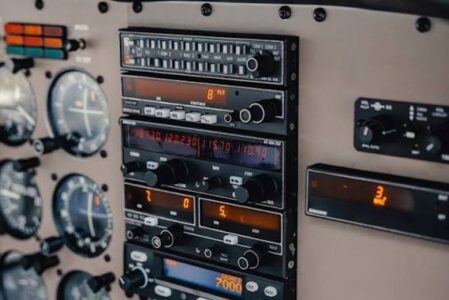
Although they are not flight instruments in the traditional sense, the communication radio and transponder are important parts of the cockpit.
The radio allows pilots to communicate with air traffic control and other relevant stations. The transponder transmits information that helps air traffic surveillance systems identify and track the aircraft.
In Australian flight training, students gradually learn how to use this equipment as part of their broader understanding of aircraft operations and airspace procedures.
What is the difference between analogue and glass cockpits?
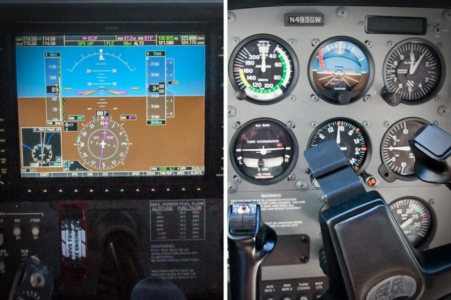
Traditional analogue cockpits use individual round gauges with needles, scales and markings. A glass cockpit uses electronic displays to present much of the same information digitally.
Analogue cockpit
- Individual round instruments with physical needles.
- Each gauge has a specific function and scale.
- Students learn to scan across separate instruments and interpret their combined indications.
- Common in many traditional training aircraft.
Glass cockpit
- Electronic screens combine several flight indications into integrated displays.
- Airspeed, altitude, attitude, heading and navigation information can be presented together.
- Some systems provide additional alerts, maps and flight-management information.
- Requires training in the particular display and system configuration.
Neither format removes the need for sound flying skills. Pilots must understand what the information means, cross-check indications and respond appropriately to changing conditions.
The basic principles learned on round-dial instruments remain valuable even when pilots progress to aircraft equipped with modern electronic displays.
Why do student pilots learn to use these instruments?
Understanding the instrument panel is a fundamental part of becoming a pilot. Early in flight training, students learn to recognise the instruments, understand their indications and relate them to what the aircraft is doing.
As training progresses, this knowledge becomes part of practical flying skills, including maintaining altitude and heading, controlling airspeed, climbing, descending and turning accurately.
Students also learn that instruments must be interpreted in context. No single gauge tells the whole story, and pilots must remain aware of the aircraft’s surroundings as well as the information in the cockpit.
With practice, the instrument scan becomes more natural. Rather than concentrating on individual dials, the student develops a broader understanding of the aircraft’s state and how to control it.
Frequently asked questions
1. What are the six basic flight instruments?
The traditional six-pack consists of the airspeed indicator, attitude indicator, altimeter, turn coordinator, heading indicator and vertical speed indicator.
2. Do all training aircraft have the same instruments?
No. The six-pack is a traditional arrangement found in many training aircraft, but the equipment varies by aircraft model and configuration. Some aircraft have additional instruments or use electronic flight displays.
3. What does the artificial horizon show?
The attitude indicator, or artificial horizon, shows the aircraft’s pitch and bank relative to the horizon. It helps pilots maintain the desired aircraft attitude.
4. Why does an aircraft need both an altimeter and a vertical speed indicator?
The altimeter indicates the aircraft’s altitude, while the vertical speed indicator shows the rate at which the aircraft is climbing or descending. They provide different but complementary information.
5. Are round-dial instruments still used in pilot training?
Yes. Many training aircraft use conventional analogue instruments. Learning to interpret them gives students a foundation in flight instrumentation that remains relevant when transitioning to more advanced aircraft and electronic displays.
6. Do pilots need to understand instruments before their first flight?
Students receive instruction appropriate to their stage of training. They do not need to master the entire instrument panel before their first lesson, but learning the basic instruments is an important early step.
7. Thinking about becoming a pilot?
Learning to interpret the cockpit instruments is one of the many skills involved in flight training. From your first lessons to more advanced navigation and commercial pilot training, you progressively build the knowledge and practical skills required to operate an aircraft safely.
At Moorabbin Aviation Services, prospective pilots can explore the training pathways available and learn more about the steps involved in pursuing a career in aviation.
Interested in learning to fly? Explore our pilot training courses or contact our team to discuss your options.
Check here : https://mas.vic.edu.au/